Critical Reflections
Body Horror and the Reconstruction of the Female Image: Challenging and Expanding the Traditional View of the Female Body
Body horror and the reconstruction of female image is an artistic issue that deeply challenges the traditional concept of female body. In contemporary cultural and artistic practice, this theme not only focuses on the direct representation of the female body, but also explores multiple aspects of gender identity, social power structures, and cultural constraints.
First, the female body is often objectified and sexualized in traditional media and art works, which not only limits the diversity of female images, but also deepens gender stereotypes. In this context, body horror, as an artistic strategy, attempts to break the shackles of traditional aesthetics by exaggerating, transforming and even deconstructing the female body image. In this way, the artist not only presents a visual impact, but also challenges and reflects on the existing gender political structure.
I refer to the work of Mariam cahn.I saw her paintings at the Venice Biennale in 2022, and immediately caught my attention. The colors and shapes are very direct and violent, and they are not shy about depicting genitals and some sexual acts or reproductive processes. Her works deeply reveal the theme of "female body terror" and explore the situation of women in the relationship between violence and power through strong visual representation. Centering on the semi-abstract and distorted female body, she uses blurred boundaries and impact colors to show the interwoven state of vulnerability and strength of the body, reflecting the experience of women being watched, controlled and hurt in society.Gender violence is an important theme in her works, which reveals the objectification and social discipline of the female body through exaggerated body language and metaphorical depiction. This performance not only shows the individual trauma, but also accuses the injustice of the gender power system. Cahn also explores issues such as fertility, motherhood and sexual exploitation through the female body as a political symbol, revealing the dynamics of oppression and resistance behind it.She aestheticizes horror, using soft and sharp colors to create visuals that are both painful and powerful, conveying the complexity of female body horror: a symbol of vulnerability as well as resistance. By challenging traditional ways of viewing, she breaks down the passive and glamorized image of the female body in art, leading the audience to confront the reality of gender violence and inequality, and delivering strong social and political reflection.
Belkis Ayon's work also inspired me. I saw her paintings at Tate Morden. Her images were quiet and mysterious, and I stopped for a long time.Through her exploration of the myth of Abakua, centered on the sacrificed female character Sikan in the myth, she reveals the marginalized status of women in the male-dominated power structure and the oppression and fear behind it. Sikan's body symbolizes religious control over women and embodies society's fear of women as potential threats as "secret holders." By reinventing this role, Ayon challenges gender power relations in traditional narratives.
Her black and white monochrome artistic language and deep texture create a disturbing atmosphere, and the silent female image symbolizes the passive status of women in the cultural and religious system and the dissolution of subjectivity. This "silence" reveals the objectification and oppression of women's bodies in society, and also implies the deprivation and control of women's expression rights.
While exploring gender and sacrifice, Ayon's work offers a new perspective on female subjectivity by reinterpreting female roles. Her art not only reveals the complex status of the female body in the power system, but also attempts to break through this limitation, showing women's reflection and struggle in the oppression, and providing profound cultural thinking for redefining the female image.
As Judith Butler puts it, "Our physical behavior is not a way of expressing some internal identity, but rather of creating what we call 'identity' in a continuous performance. Gender is the act rather than the fact itself."(Butler, 1990, p. 136) This view challenges traditional gender dualism and rejects the view of men and women as groups with fixed and immutable characteristics. Through this theoretical perspective, the body is no longer a container for passive acceptance of cultural and social norms, but an active field of gender construction. The performability of gender reveals the political nature of the body in cultural and political contexts - the body is shaped and understood in social norms and power relations through repeated actions and performances.
This theoretical framework has provided many feminist artists with ideas to criticize traditional notions and expectations of the female body. For example, by distorting and reconstructing the image of women, artists not only challenge the idea that gender is fixed, but also criticize the cultural and social norms that shape and limit the female body. As Butler points out, "The deregulated performance of the body is a way of redefining the boundaries of reality, challenging seemingly natural and immutable norms." (Judith Butler, Bodies That Matter: On the Discursive Limits of Sex, 1993, p. 10) This view provides theoretical support for the understanding of body terror and female image reconstruction in art, and emphasizes art as a tool to intervene and comment on gender politics.
From a broader socio-cultural perspective, body phobia and the reconstruction of female image are also related to women's status and power in society. In many cultures, women are associated with physical passivity, vulnerability, and the identity of the object of view. Through the expression of physical terror in art, this solidified gender dynamic relationship can be revealed and criticized. This is not only a challenge to viewers' viewing habits, but also an attempt to reconstruct women's agency in cultural narratives.
Carol J. Clover wrote about the character of the "Final Girl" in horror movies in Rampage Body: “She is the one who did not die: the survivor, the image of all of us who, by dint of intelligence, vigilance, determination, and purity, escape the vengeful wrath of the killer. "(Clover, 1992, p. 35) Clover pointed out that this image not only represents her own struggle for survival, but also projects the audience's empathy, especially in the gendered narrative. The "Last girl" is particularly important as a symbol of resistance to violence and death. Her survival is not only a turning point in the plot, but also a challenge to traditional narrative conventions that portray women as weak or victims. Clover's theory inspires us to reflect on the diversity and complexity of female representation in horror films. Although "The Last Girl" may be derived from the reinforcement of gender violence, her existence also breaks through the traditional constraints of female roles, showing a side of strength and independence. This concept is of great significance for understanding the representation of female subjectivity in works of art.
Jack Zipes wrote in The Politics of Fairy Tales: “Fairy tales have always reflected the power structures of societies, and the female protagonist is often caught in the struggle to overcome these constraints. "(Zipes, 1983, p. 25) He analyzes how fairy tales reflect the power structure of society, and his theory provides us with a framework to interpret the contradictory nature of women's roles in folk tales: they are both passive recipients of social power and active agents of change. This contradiction provides rich material for artistic creation, enabling artists to re-examine and reconstruct the female image to challenge the stereotyped gender concept in traditional culture.
These theories have provided me with critical tools to analyze and reflect on the place of the female body in cultural and social structures. Through painting, I emphasize the subjectivity of women, resist gender and objectification, and provide a new perspective for understanding and changing the image and role of women in modern society. In my art practice, the female images in horror films and folk tales are the core objects of research. I have a keen interest in horror movies and folk tales, and after watching a lot of movies, I find that the female characters in these films often impress me.
Take the banshee in Painted Skin as an example. As a classic story in Pu Songling's Tales of Liaozhai in the Qing Dynasty, this work tells the story of a banshee who disguises herself as a beautiful woman by wearing human skin in order to approach and absorb the vitality of men. "Painted Skin" not only depicts the story of the banshee's use of human skin for camouflage, but more importantly, it deeply challenges the traditional double standard about female beauty and danger. Through this narrative, the story presents the complexity of female image, and also reveals the conflict and contradiction of gender power relations.
The banshees' human skin disguises the fact that women in society often need to change themselves in order to fit in or challenge male-dominated social structures. This kind of camouflage is not only the cover up of the appearance, but also the concealment and suppression of the inner nature, reflecting the various pressures and challenges faced by women in the social culture.
In general, horror films often portray female characters as passive, fearful, or victimized, which reflects social stereotypes about women's vulnerability and also reflects the cultural solidification of gender power relations. Folk stories portray women through gender codes and character expectations, often associated with sacrifice, endurance, and supernatural power, reflecting cultural expectations for female characters. By studying these stories, I explore the construction of female identity in traditional culture, and try to reconstruct the stories from a modern perspective to express more equal and diverse gender concepts.
For example, the banshee in Painted Skin touches on how women challenge and subvert traditional gender roles by changing their appearance. This challenge is not only a redefinition of individual identity, but also a critique of gender dynamics in society. This coincides with my artistic goal of breaking gender stereotypes and re-empowering women and subjectivity through the creation of distorted and mutated female images.
Through body horror and the reconstruction of the female image, we can not only broaden our understanding of the female body, but also promote a broader discussion of gender equality, cultural diversity, and social justice.


Miriam Cahn, “ohne titel, 11.5.17” (2017), oil on canvas, 17.32 x 13.4 inches
Miriam Cahn, junge weltäffin, 1998, oil on canvas, 52 x 84 cm
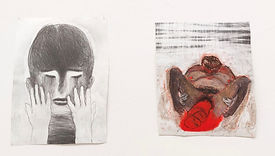
Miriam Cahn, Published in Venice Art Biennale 2022

Belkis Ayón The Supper 1991

Sandra Vásquez de la Horra, Awake I Wait for You 2022
Bibliography
Butler, J. (1990). Gender trouble: Feminism and the subversion of identity. Routledge.
Butler, J. (1993). Bodies that matter: On the discursive limits of sex. Routledge.
Clover, C. J. (1992). Men, women, and chain saws: Gender in the modern horror film. Princeton University Press.
Zipes, J. (1983). Fairy tales and the art of subversion: The classical genre for children and the process of civilization. Routledge.