Touching the Chaos: Exploring the Boundaries of Body and Existence through Monster Imagery
【1. Introduction】
My artistic practice has undergone a transition from addressing gender-based violence and the objectification of the female body in the previous semester to a deeper exploration of self-fragility, bodily boundaries, and existential anxiety in the current stage.
This shift was not an impulsive decision but the result of prolonged self-doubt, introspection, and repositioning.
Initially, I approached the female body through references to horror films, aiming to challenge body-related fears and reconstruct female imagery. However, as my practice progressed, I gradually realized that what truly fueled my desire to create was not merely the narrative of social gender issues, but deeper concerns: the fragility of the body, the fluidity of boundaries, and the uncertainty of existence itself. Existential anxiety became the profound driving force behind my work, and the "monster" — as a symbol of bodily alienation — evolved into a crucial medium through which I attempted to express these anxieties.
【2. From Instinct to Consciousness: The Awakening of Thematic Awareness】
At the initial stage of my creation, painting was primarily an instinctive emotional release.
Without sketches or planning, I relied purely on intuition, randomly smearing pigments onto the canvas. Following the traces left by these gestures, monstrous forms naturally emerged alongside the flow of emotions.
At that stage, I had no clear awareness of what exactly I was depicting. There was little theoretical reflection or rational processing; the images simply broke apart, reassembled, and evolved in response to emotional impulses.
As the process deepened, I began to reflect: What do these monsters mean to me? What compels me to persistently portray them?
I gradually realized that I was attempting to create a world of monsters in constant flux and transformation — creatures born from imagination yet laden with fragments of emotions, memories, and perceptions drawn from the subconscious. These monsters had no fixed names, species, or purposes; they existed in states of ambiguity, change, and incompleteness.
My practice was neither a direct visualization of emotion nor a theoretical demonstration; rather, it was a form of free expression woven from imagination — a process of "touching the chaos" blindly, sensing the unspeakable realms of the inner world.
Through analyzing my own works, I came to understand that the monstrous forms often exhibited fragmentation, fluidity, and blurred boundaries — essentially depicting the loosening, deformation, extension, and rupture of bodily borders.
This realization marked a transition from unconscious emotional expression to conscious thematic exploration, leading me toward a deeper understanding of bodily sensitivity and existential fragility.
【3. Monsters and Existential Anxiety】
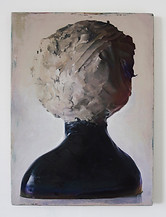
In the process of deepening my exploration, the work of Damien Meade provided significant inspiration.
Using unfired clay models as prototypes, Meade paints figures that seem to hover between life and death, radiating a fragile yet dense presence. These rough, blurred visages appear eternally incomplete, exuding an inexpressible loneliness and vulnerability.
In Meade’s paintings, the body loses the stability of its borders, the face refuses clear identification, and existence itself wavers between collapse and regeneration. As Davide Ferri observes, "Meade's figures have faces without gaze; this is why they are disturbing, because the eye conceals something unsettling within itself, which comes to light just when the gaze is absent."
This absence of gaze disrupts the reciprocal relationship between the figure and the viewer, evoking deep unease — a quality that profoundly resonates with the monsters in my own work: creatures without fixed identity or clear boundaries, embodying only flux and instability.
Geraint Evans further notes, "Meade's paintings are often inspired by the last breath at the moment of death, focusing on that delicate boundary between life and death."
This perspective aligns closely with Julia Kristeva's concept of abjection in Powers of Horror, where she describes abjection as a mental revolt against the boundaries of existence, exposing the most fragile cracks in human perception:
"When the absolute boundary between life and death is torn apart by the sight of a corpse, we are forced to confront the absurdity of existence."
However, in my practice, monsters do not directly symbolize the border between life and death. Rather, they primarily manifest the unspeakable chaos of the inner world. The fluidity and instability of these figures mirror the flux and instability of emotional and psychological states, which themselves are at the core of existential anxiety.
What my monsters represent is not the definition of identity nor external threats, but the shifting, chaotic terrains of emotional turbulence within.
【4. A Deepening Exploration of Bodily Boundaries】
During my investigation of bodily boundaries, the works of Teresa Pągowska provided a critical point of resonance.
At an exhibition held at the Thaddaeus Ropac Gallery, I encountered her paintings firsthand.
Pągowska is known for her intimate, tactile depictions of female figures and her experimental technique of painting on raw, unprimed canvas. Her figures dissolve and deform within the pictorial space, marking a departure from the mechanical representations of the body associated with pre-World War II modernism, toward a liberated, sensory mode of depiction.
In Pągowska's paintings, although the figures retain partial figuration, their blurred contours and destabilized relationship to space dissolve the body's function as a fixed, stable container.
Instead, the body becomes a field of flowing emotions and perceptions.
This treatment of the body strongly resonates with my portrayal of monsters: figures whose dissolving, fragmented, and unfinished forms reveal the instability of bodily boundaries, echoing the emotional fractures and existential anxiety I seek to express.
During the exhibition, I was particularly drawn to how her figures gradually lose their spatial integrity, becoming ambiguous presences woven from perception and emotion.
This led me to a deeper realization: that the blurring of bodily boundaries is not merely a physical phenomenon, but also a collapse at the psychological and emotional levels.
The uncertainty we experience when perceiving the edges of our own bodies parallels the fundamental anxiety of existence.
Through Pągowska’s treatment of bodily tactility and boundary dissolution, I found an artistic pathway to connect the imagery of monsters in my work to the instability and flowing nature of the inner emotional landscape.
【5. Theoretical Supports and Deepened Understanding】
At a theoretical level, Susan Stewart in On Longing points out that the body is both a container and what is contained, constantly directing our attention toward its "borders and limits."
She draws on Jacques Lacan's concept of "erogenous zones," suggesting that bodily fissures and apertures — such as the lips, eyes, and anus — emphasize the experience of "edges" and "boundaries" by separating the organic functions from the body’s surface.
This theoretical framework deepened my understanding of monster imagery.
The monsters I create are not simply grotesque representations of bodily deformation; rather, the fissures, orifices, and ruptures they exhibit are visualizations of emotional fractures and psychological instability.
My monsters do not exist as complete or stable beings — they are suspended in a constant state of flux, fragmentation, and reconstruction.
Through the loosening of bodily boundaries, they embody the chaotic instability of the inner emotional world and the existential anxiety inherent in the uncertainty of self.
【5. My own interpretation of the work】
"burn" was created after I experienced emotional trauma and is a direct emotional response. The female face in the picture is covered by large areas of blurry color blocks, with indistinct facial boundaries and the face almost blending with the wound. I attempt to present the sense of tearing at the psychological level through this ambiguous and cracked form. She is not a specific "she", but the "I" in my emotional projection - an incomplete, wavering and self-uncertain state after being hurt in an intimate relationship. The blood and skin colors in the picture interweave, creating a layer upon layer of disturbing tactile sensations, which is precisely the embodiment of the concept in my creation that "wounds are both exits and entrances".
In contrast, "ecdysis" is more like a partial fragment stripped from the monster world. This work depicts a piece of fur tissue scattered in the snow, suggesting that it originally belonged to a complete life form but now exists in the form of fragments. This work does not depict the monster directly. Instead, it expresses a kind of "silence after being watched" through remnants - it is both a relic after violence and a metaphor about losing control, fear and the end of existence. It made me start to think: When a monster is "shattered", can it still carry emotions? Are these fragments closer to reality? When the monster was "shattered", it did not lose its original ability to carry emotions. Instead, it conveyed a deep sense of unease and truth more precisely in a fragmented way. In my works, the broken structures, blurred edges and local forms themselves are evidence of trauma. Rather than saying that fragments are the result of imperfection, it is more accurate to say that they are the most realistic manifestation of psychological experience and emotional state. Because emotions are never complete, stable and controllable; they are often fragmented, intermittent and difficult to integrate. Therefore, fragments can not only carry emotions but are even more expressive than complete images. They stimulate the viewer's imagination of what is missing and also leave more space for emotional projection.
【7. Conclusion】
Through this critical reflection, I have come to recognize more clearly that the monster imagery in my work is not merely an exercise in visual grotesquery.
Rather, it represents an in-depth exploration of the intersection of abjection, bodily alienation, and existential anxiety.
Monsters symbolize the fragility and rupture of the self’s boundaries; they carry my confrontation with emotional chaos, the finitude of life, and the absurdity of existence.
In my future practice, I intend to continue deepening my exploration of bodily fluidity, emotional tension, and existential fissures, seeking to depict — with greater subtlety and depth — that chaotic inner realm which, though ultimately ungraspable, remains vital to touch and to express.
Bibliography
Evans, G. (2012). Damien Meade: A History of Fear. Turps Banana Magazine, March 2012.
Ferri, D. (2018). On Damien Meade’s Paintings. Exhibition text for Damien Meade's solo show at CAR DRDE Gallery, Bologna, September 2018.
Kristeva, J. (1982). Powers of horror: An essay on abjection. Columbia University Press.
Lacan, J. (1977). Écrits: A selection (A. Sheridan, Trans.). W. W. Norton & Company.
Stewart, S. (1993). On longing: Narratives of the miniature, the gigantic, the souvenir, the collection. Duke University Press.

janus
2013 Oil on linen 44 x 32 cm
_2013_edi.jpg)
Vangelis (LoveTheme)
2013 Oil on linen 35 x 27 cm
Talcum
2011 Oil on linen 66.5 x 44.5 cm


Untitled, 1966
Oil on canvas,146 x 130 cm
Magiczna grupa II (Magic group II), 1978
Acrylic on canvas,160 x 150 cm
Untitled, 1969
Oil on canvas,146 x 130 cm


burn,40x40cm,oil on canvas
ecdysis,60x80cm,oil on linen